11 October 2024
by Andrei ALECSESCU
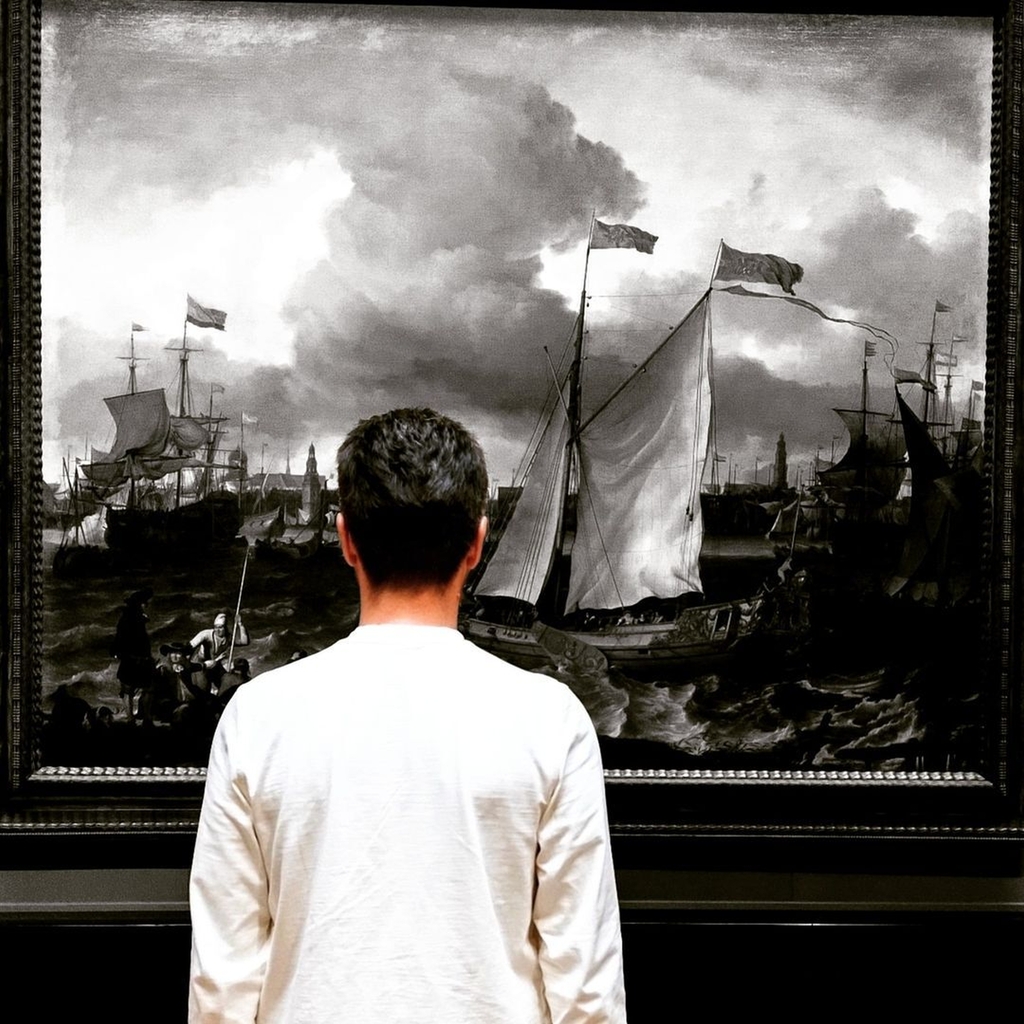
In recent decades, contemporary painting has become the arena for radical transformations, during which the traditional boundaries of art have been undermined, and the distinction between what can be considered authentic artistic creation and what merely represents a fleeting gesture has become increasingly blurred. While in the past painting was perceived as an erudite form of art, subject to rigorous criteria of technical, aesthetic, and conceptual evaluation, today we observe a profound dilution of these criteria, such that almost any visual manifestation can be claimed as "ART." This unprecedented expansion of the artistic field, accompanied by an apparent democratization of access to the status of "ARTIST," has, however, led to the proliferation of a dangerous aesthetic relativism that tends to transform the act of painting into a mere trivial gesture.
Contemporary painting thus faces an identity crisis, generated by an almost total abandonment of traditional criteria of technical excellence and artistic mastery in favour of a conceptual approach where the idea takes precedence over form. In an attempt to free itself from academic constraints and to open new avenues for exploration, painting has detached itself from the rigours of craftsmanship, often completely disregarding the importance of composition, colour, or execution virtuosity. This attitude, although initially associated with the avant-garde revolution that began in the early 20th century, has lost its subversive character, becoming a cliché in itself, a template devoid of intellectual substance.
An emblematic example of this phenomenon is the rise of conceptual art, which, while contributing to the broadening of artistic horizons, has simultaneously led to the marginalisation of painting's value as an independent artistic medium. Instead of sophisticated plastic expression, we now witness a banalisation of the pictorial gesture, where technique is often deemed irrelevant and the idea is elevated to a pedestal, even when it lacks complexity or substance. Consequently, many works exhibited in contemporary galleries are reduced to mere attempts to shock or provoke, without any genuine concern for exploring aesthetic depth or human meaning.
This decline is exacerbated by the economic mechanisms that govern the contemporary art market, where the commercial value of a painting often prevails over its artistic worth. In a visual culture dominated by instantaneity and rapid consumption, paintings are frequently created to attract attention through elements of eccentricity or even the grotesque, no longer adhering to objective criteria of value. This phenomenon, in which marketing and financial speculation play a central role, leads to the elevation of works that do not invite contemplation, reflection, or aesthetic admiration, but rather provide a superficial and transient visual experience.
A symptomatic case of this aesthetic relativism is the increasingly frequent tendency to transform banal elements or random gestures into "paintings," relying solely on a theoretical justification that confers a false legitimacy upon them. Paintings created by randomly throwing paint onto a canvas or through careless application of colour are today presented as masterpieces, without any demands regarding formal complexity or technical rigour. In such a context, excessive conceptualisation replaces the artistic process itself, and painting becomes, in essence, a mere vehicle for trivial or provocative ideas, with no real concern for the quality of execution or the aesthetic impact that a well-crafted work can have.
This trend of undermining traditional values in painting is further accentuated by a critical rhetoric that tends to justify any form of experimentation as a profound innovation. In many cases, art critics and theorists legitimise mediocre or trivial works through sophisticated discourse, ignoring the fact that, in the absence of a solid aesthetic foundation, these works remain devoid of substance. As a result, contemporary painting risks becoming a parody of its own history, increasingly distancing itself from the nobility and complexity of previous forms of expression.
Nevertheless, it cannot be overlooked that this "liberation" of painting from traditional constraints has allowed for the exploration of new and unconventional territories of artistic expression, bringing to the forefront themes and subjects that were previously excluded from the realm of art. However, the inherent risk of this unfettered freedom is the potential to trivialise the very notion of art, reducing it to a mere game of superficial ideas and theatrical gestures.
In the face of this aesthetic drift, contemporary painting finds itself at a turning point: will it continue to sink into the absurdity of an exacerbated relativism, where anything can be considered art, or will it succeed in regaining its balance, revaluing technical excellence and aesthetic depth? In the absence of a rebalancing between creative freedom and formal rigor, painting risks becoming a mere form of exhibitionism, stripped of its profound significance and reduced to a vehicle for a dangerous intellectual superficiality.
Thus, the fundamental question remains: how can painting regain its status as an erudite art form capable of expressing the essence of human experience in a context where the absurd and banal are frequently glorified as artistic innovations? Only through a critical reevaluation of values and a return to profound aesthetic demands can painting hope to overcome its current impasse and reclaim an authentic space for artistic exploration.
