25 October 2024
by Andrei ALECSESCU
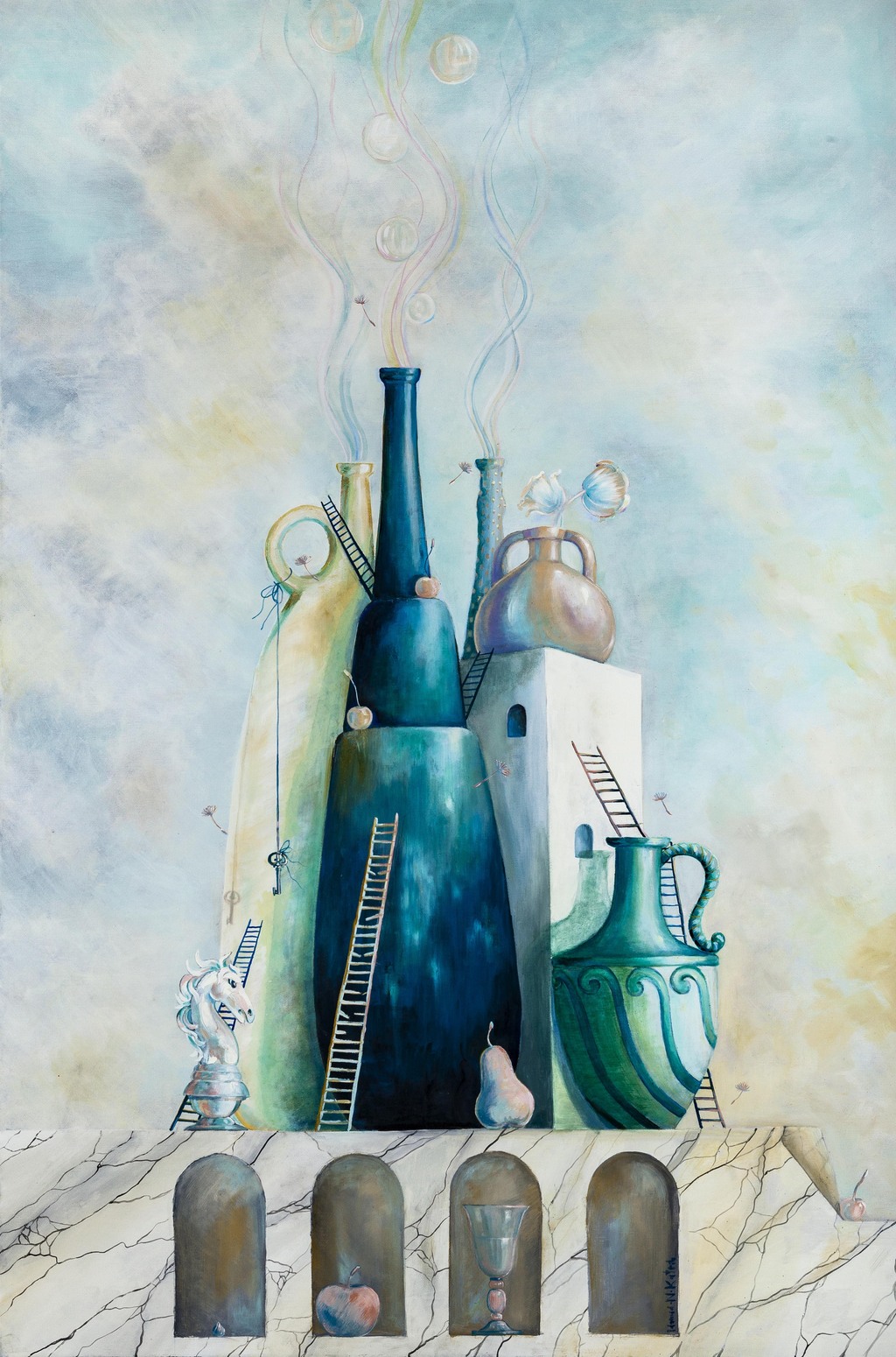
In an artistic paradigm dominated by technique and immediately recognisable visual landmarks, Hamid Nicola KATRIB, through his work "EVOLUTION", proposes an aesthetic discourse that transcends the limitations of conventional representations. This large-scale painting (80 x 120 cm), executed in oil on canvas, not only rejects the linear clarity of narrative but also constructs a meticulously elaborated space where symbolism, surrealism, and metaphysical meditation converge into an image of transformation and ascension. "EVOLUTION" thus occupies a position at the intersection of visual art and philosophy, offering the viewer a window into a profound understanding of human becoming.
The entire framework of the work is dominated by an improbable architecture, characterised by forms that rise vertically, evoking transcendence and the aspiration towards another level of existence. The main structures – bottles, amphorae, and stylised vessels – are massive, strongly defined, and arranged hieratically. These are far from being mere household objects; they function as archetypal topos of the accumulation of knowledge, experience, and evolution. Each architectural element is sprinkled with fragile, seemingly non-functional stairs, reinforcing the idea of ascension, as well as the precarious and uncertain effort involved. The lines of these stairs, alongside the disproportionate dimensions of the containers, create a state of paradox: on one hand, the continuous aspiration; on the other, the inevitable fragility of human endeavours.
From a compositional perspective, the work is balanced, yet asymmetrical, thus imparting a sense of dynamism and controlled imbalance. The tall, partially connected structures are set against an ethereal background defined by a diffuse atmosphere, where pastel tones of blue, green, and ochre dominate the scene. These calm and cool hues evoke a feeling of peace, while the architectural forms, through their verticality, express an ineffable desire for ascendance, remaining anchored nonetheless in an uneven, cracked earthly base. The airy, almost diaphanous background suggests a "liminal" space between the concrete and the abstract, between the material and the transcendent.
The vases and bottles are central elements of the work, but they represent more than mere physical objects; they carry multiple meanings. In the history of art, vases are often associated with concepts of fertility, the preservation of knowledge or essence, and are frequently used in the context of alchemical symbolism. In KATRIB's work, these vessels acquire a dual significance: on one hand, they evoke the accumulation of experience and knowledge; on the other, they symbolise existential contingency, being empty or emanating ephemeral steam and bubbles – fragile signs of an ongoing process of transformation.
Each staircase, whether connected to a vessel or not, represents the effort of evolution. Although they are pathways, the stairs are precariously positioned, suggesting that ascension is marked by uncertainty and the risk of failure. This can be interpreted as a meditation on the human condition, in which progress is never guaranteed, and inner evolution represents a personalised process filled with obstacles and dilemmas. Thus, the stairs become metaphors for personal search, the struggle for self-overcoming, and self-definition.
Another symbolically significant element is the figure of a stylised white horse, positioned in the lower left of the composition, reminiscent of a chess piece. This presence evokes the idea of a strategic game, where every move must be carefully calculated. In the thematic context of the work, the chess horse can be interpreted as a symbol of the duality of evolution: on one hand, ascension requires effort and strategy; on the other hand, there is always an element of unpredictability and fate. Thus, the presence of the chess horse brings to the forefront a subtle idea: progress, whether personal or collective, is a game of balance between reason and uncertainty.
The background of the work, with its misty sky and diffuse colours, complements the theme of ascension and ephemerality. The smoke and bubbles rising from the vessels suggest an ongoing alchemical process. These are not mere decorations; they indicate the volatility and temporality of progress – evolution being an accumulation of experiences that, once distilled, lose their form and meaning over time. The smoke, like the fragile stairs, illustrates the fact that any ascent is marked by entropy and inevitable degradation, thus paving the way for a broader reflection on the ephemerality of existence.
Time, indeed, is omnipresent in this work. The cracks on the marble surface suggest an eroded past, a history of trials and failures, serving as a constant reminder of human fragility. This tense landscape, situated between fragility and resilience, implies that evolution is not a linear and triumphant process, but a cyclical one, marked by trials, failures, and successive rebirths.
The work "EVOLUTION" by Hamid Nicola KATRIB transcends the limits of a conventional representation of human progress, instead offering a complex meditation on the nature of ascension, continuous effort, and our inevitable fragility. KATRIB constructs a symbolic landscape, rich in multiple meanings, where each visual element carries philosophical and aesthetic significance. The painting thus becomes a meeting space between materiality and immateriality, between the concrete and the ephemeral, inviting the viewer not only to visual contemplation but also to profound introspection regarding their own existential journey. Each staircase, each vessel, and each crack in the lower marble reflects the story of human effort, the struggle for evolution, and the inevitable awareness of the imperfections of this journey. "EVOLUTION" is, in essence, a work about becoming, a visual illustration of a consciousness in constant pursuit of transcendence.
