31 January 2025
by Andrei ALECSESCU
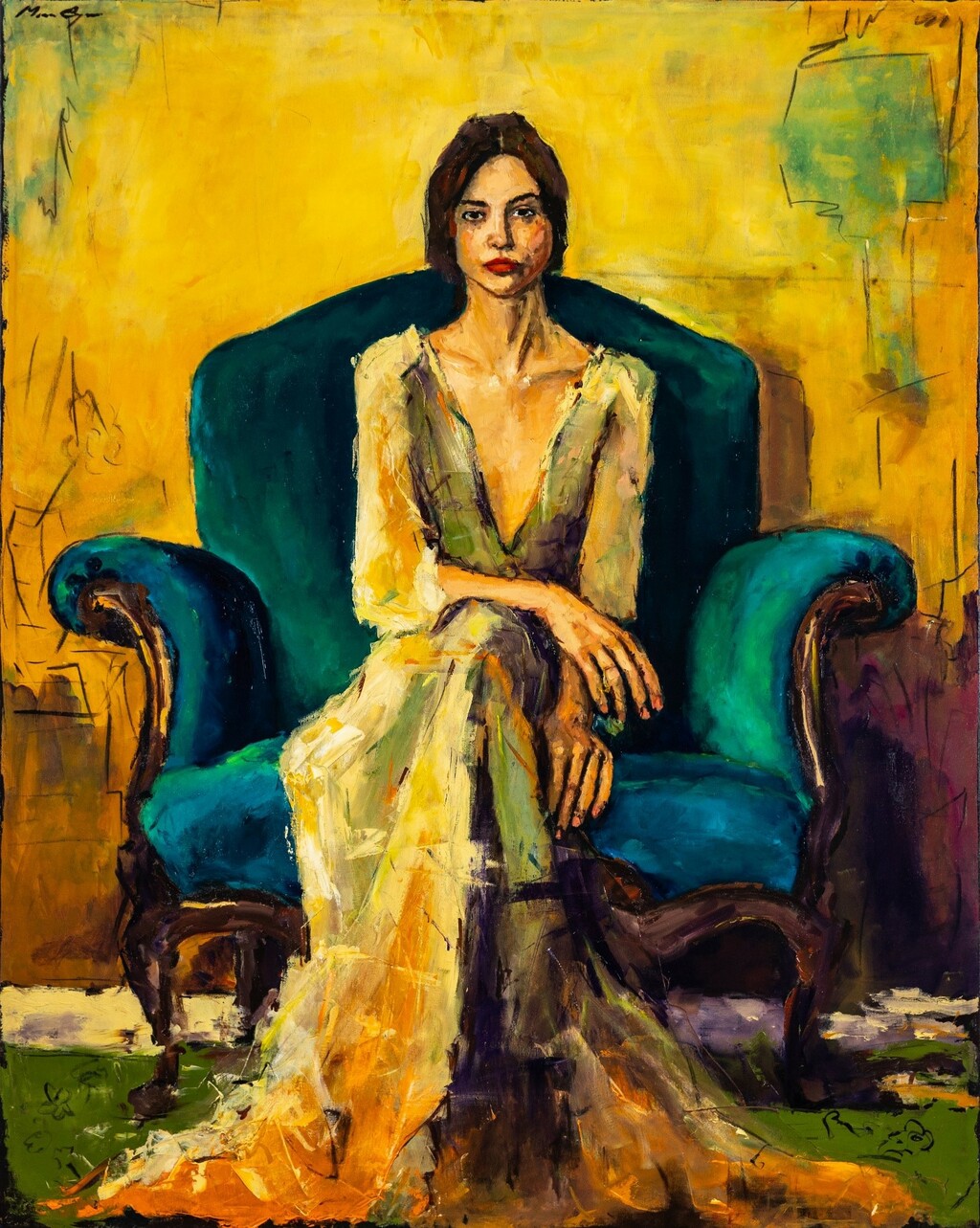
In an art world dominated by ephemeral visual discourses and compositions that are sometimes sterilely technicalized, Miruna COJANU offers a painting imbued with deep psychological substance—a portrait that transcends mere representation to become an introspective journey into the subject’s intimate universe. Chapter 7: Her Very Guilty Pleasures is not merely a fragment of an untold story but a bridge between figuration and expressionism, between materiality and fleeting emotional states. The painting captures a moment of suspended contemplation, a scene of silence in which the viewer is both invited in and kept at a distance. It is a work of visual and conceptual contradictions: the static nature of the pose versus the energy of the brushwork, the subject’s fragility versus the authority of the composition, personal intimacy versus the exposure of the gaze.
The large dimensions of the canvas (125 x 100 cm) impose a direct, almost intrusive encounter with the subject. The female figure is positioned frontally, in an expectant posture that evokes a classical portrait, yet one distorted by expressionist accents. The massive armchair, painted in a deep blue, violently contrasts with the incandescent background, creating a visual force that draws the eye towards the woman’s face and hands. The colour contrasts are masterfully employed: yellow, a symbol of light and exposure, seems to become a threatening, almost suffocating backdrop, while the cool blue of the armchair suggests isolation, introspection, or even melancholy. This interplay of colours recalls the dramatic tensions of German Expressionism, where colour is not merely an aesthetic element but a conduit for raw emotion. However, beyond the obvious visual architecture, fine details reveal a meticulous psychological depth. The hands, exaggerated in expression and position, emphasise the subject’s corporeality, marking a tension between grace and discomfort. The gaze, slightly evasive, does not establish direct eye contact but neither does it fully avoid the viewer—an ambiguity that heightens the emotional complexity of the scene. The fabric of the dress, rendered through fragmented brushstrokes, seems to dissolve into the background, blurring the boundary between the character and her surroundings. This dissolution is reminiscent of the works of Egon Schiele, where the figure becomes an extension of its own psychological universe.
From a technical standpoint, the work blends elements of figurative expressionism with post-impressionist influences. The brushstrokes are vigorous, almost brutal in the treatment of the background, yet delicate in shaping the face and hands. This dual approach suggests an inner duality—a tumultuous internal world concealed beneath an outwardly calm façade, a tension between hidden sensitivity and manifest aggression. The colour palette echoes Fauvism, particularly Henri Matisse, in the way colours do not imitate reality but rather reinvent it. However, unlike the Fauvist celebration of sensation, COJANU maintains a latent psychological tension, more akin to the expressionism of Oskar Kokoschka or Francis Bacon. The gestural quality and chromatic substance also draw parallels with Willem de Kooning’s abstract expressionism, where figuration unravels under the sheer energy of colour. In this sense, the painting is not merely a representation but an active visual process, where the viewer can sense the movement of the brush, the impulsive direction of the strokes, the internal rhythm of the artist.
Unexpectedly, the title—Chapter 7: Her Very Guilty Pleasures—introduces a literary dimension to the interpretation of the work. The phrase "Chapter 7" suggests that this painting is not an isolated entity but part of a broader story, a visual narrative unfolding in successive episodes. But what does "guilty pleasures" mean in this context? Does it refer to repressed hedonism, unspoken desires, or a precarious balance between guilt and pleasure? The title leaves room for multiple interpretations, and its ambiguity only deepens the mystery of the portrait. This fusion of painting and narrative evokes a cinematic aesthetic, where each frame functions as a window into a larger story. Thus, COJANU’s work transcends the status of a mere painting—it becomes a visual sequence from an unwritten film, an enigmatic fragment where each viewer is free to project their own version of the story.
Chapter 7: Her Very Guilty Pleasures stands out both for its remarkable visual power and for its subtle emotional fragility. COJANU demonstrates a profound understanding of human expression, using colour and composition not merely as tools of representation but as vehicles for conveying emotion, tension, and ambiguity. This is not a painting that offers answers but one that poses questions. Who is this woman? What story does she conceal? Is she an image from the past, a portrait of the present, or a projection of the inner self? In this complexity lies the true artistic value of the work—it does not impose certainties but wields the power to provoke introspection. COJANU does not simply create images; she constructs spaces of reflection, where the viewer becomes part of the process of interpretation. Consequently, Chapter 7: Her Very Guilty Pleasures is not just a chapter in a story but a visual meditation on identity, introspection, and desire—a painting that lingers in the viewer’s mind long after the gaze has shifted elsewhere.
