7 April 2025
by Andrei ALECSESCU
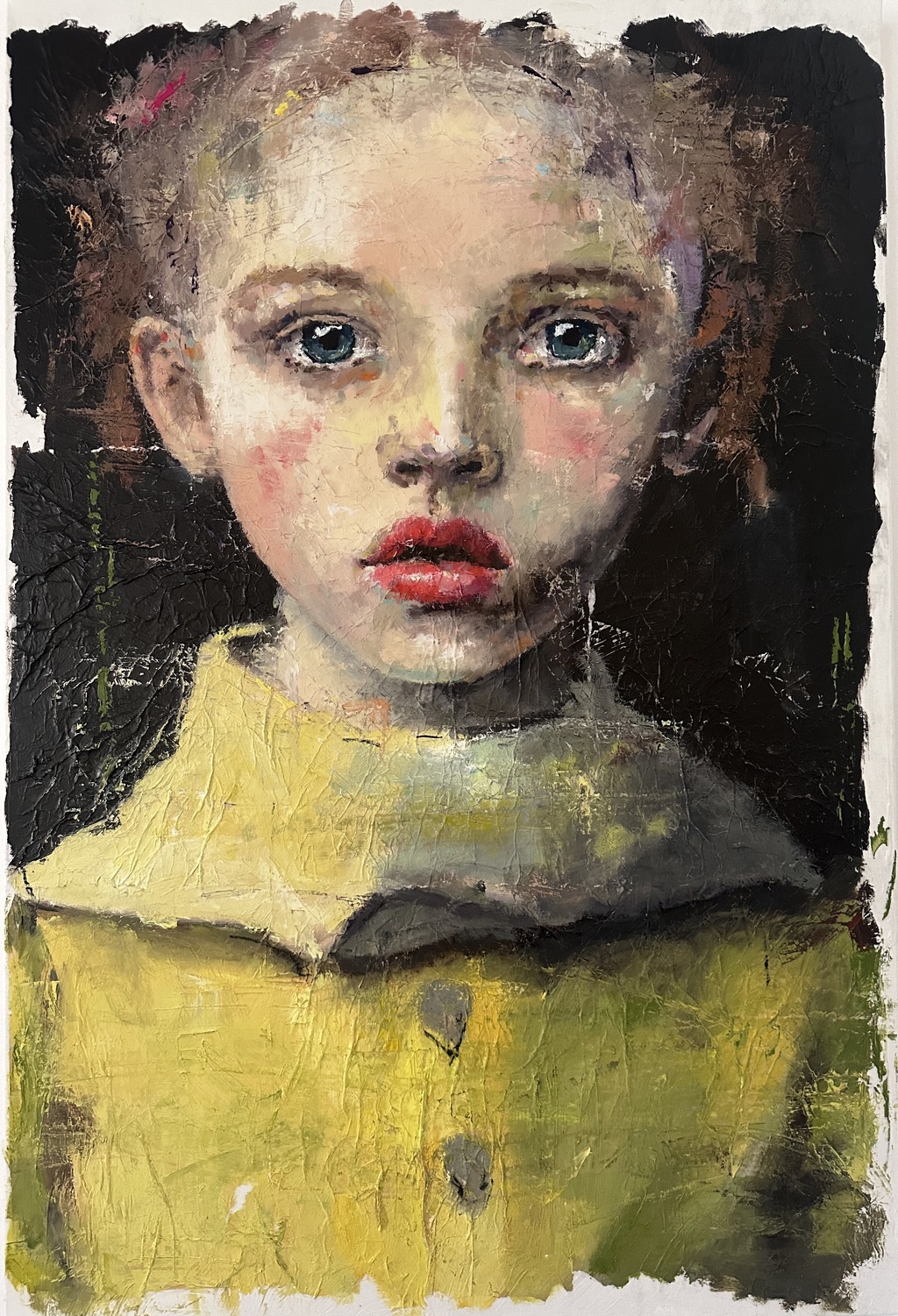
There are works that are looked at, and there are works that look back. Miruna COJANU’s painting, What I Have Kept of Myself, belongs to the second category. It is not just a painting, but a subtle return to that inner space where identity is shaped in silence, where the being has no name, only color, gesture, and waiting. Created in oil on paper on canvas, with dimensions of 120x80 cm, the work transcends conventional form to become a liminal space between the visible and the invisible, between the self of yesterday and the self still possible.
This work does not present itself, but reveals itself. It does not assert, but whispers. The almost epidermic texture covers and uncovers simultaneously, like a half-forgotten memory that refuses to die. It is less a portrait and more a palimpsest of the self – layer upon layer, gesture upon gesture, a past that breathes quietly beneath the surface of the present.
/ The Gaze as Genesis and Restoration /
The girl in the painting is not just a character, but an embodiment of the original being. She does not look at us; rather, she opens our eyes to what we have forgotten to look at within ourselves. In this gaze lies the seed of a lost world, but not definitively. It is not the conventional innocence, but a form of early lucidity – as if the soul, newly arrived in the world, already carries the nostalgia of the light before birth.
In this little girl, we find what Proust would call "the time regained" – a state suspended between memory and revelation. It is not the past returning, but a past that never left. It is that fundamental layer of being that time cannot exhaust, only cover, hide, or protect.
/ Yellow as Ontological Light /
The yellow dress is not a garment, but a radiation. In the symbolic logic of the work, this yellow is more than a color – it is a way of being. A light that does not come from the outside, but from the core of being. It is what we would have been if we had not strayed into conventions, language, and adult mechanisms.
This yellow does not say "look at me," but "return to yourself." It is neither a solarium nor forced optimism – it is hope as an act of ontological resistance. In an increasingly dull world, the girl in the painting preserves not only color but also the reason to still believe in it.
In the tradition of Byzantine iconography, the color yellow (golden) was often used to symbolize divine light, the presence of the sacred that escapes the laws of matter. This parallel is not coincidental – in What I Have Kept of Myself, yellow becomes a form of inner sacredness. The light does not come from an external source, but pulses from within the being. It is, in a profound sense, a transfiguration. Thus, the painting does not only evoke childhood as a biographical moment but an almost Edenic, archetypal state.
/ Embodied Memory and Suspended Temporality /
In line with Merleau-Ponty’s thinking, which regarded the body as the fundamental expression of perception, the work is constituted as a corporealization of memory. We are not dealing with a mere portrait, but with an incarnation of affective past. The dark background is not emptiness but sedimented matter – the space of the forgotten, the repressed, from which the figure of the girl emerges as an act of retrieval.
It is a memory that was never fully conscious but has infiltrated gestures, reflexes, the way we see the world. In this sense, the painting functions like Proust's "madeleine" – not because it reminds us of something specific, but because it reactivates a whole way of feeling – visceral, undefined, real.
The girl's gaze can also be thought of in terms of Sartre’s phenomenology of vision. It is not a gaze of domination, but one of mutual revelation – making us aware of our own vulnerability, but also of our own uprightness. In that meeting of gazes, a true anamnesis takes place – a reminder of who we are, beyond the mask.
/ Being as Fragment – Painting as Restoration /
The work does not answer the question "who am I?" but a much more subtle one – "what is still alive from what I was?" It is not an idealized reconstruction of childhood, but a silent confession of what remains when everything else has dissolved. It is, as Heidegger would say, a way of letting being show itself in its own light – without mask, without artifice.
In this sense, the painting is more of an ontological resistance. In a world that continually demands adaptation, efficiency, self-forgetfulness, Miruna COJANU recovers, through this artistic gesture, that part of being that refused to conform. That gaze which still knows how to hope, that yellow which has not forgotten how to love the light.
Perhaps the aesthetics of the work also betray a subtle influence of German Expressionism – that ability to convey the psychic tension of the interior through subtle deformation, through chromatic accumulation, through a precarious balance between delicacy and intensity. Or perhaps there is a hidden line leading from Egon Schiele, with his vulnerable corporeality, to Paula Modersohn-Becker, with the silent gaze of neglected childhood.
/ Painting as a Place of Becoming and Staying /
Positioning itself at the border between memory and dream, between loss and preservation, the work achieves the rare performance of suspending time. We do not know whether the girl has been, is, or will be. We only know that she is looking. And in that gaze, a whole ontology of becoming is concentrated – being not as substance, but as relationship, as living memory, as a desire for light.
What I Have Kept of Myself is not a question with an answer. It is a question that is lived. It is contemplated. It is allowed to burn slowly, like a silent wick deep in the being. It is a painting that does not offer a truth, but a presence. A vibration. A silent testimony that, despite all the wounds, something in us has always known how to look toward the light.
/ Archetypes, Dream, and Shadow – A Jungian Key /
Viewed through the lens of Jungian analytical psychology, the figure of the girl takes on an archetypal dimension – she is not merely an individual memory, but a manifestation of the inner child, that atemporal instance of the soul that preserves our untouched essence. In Jung's theory, the child symbolizes pure potential, renewal, but also absolute vulnerability.
The yellow dress, as an extension of the inner light, can be seen as an aura of the Self – the center of psychic totality, what we become in the process of individuation. The girl's gaze is a call to this path, an invitation to integrate our shadows, to reconcile with the lost fragments.
In that space between clarity and obscurity, the painting becomes not only an aesthetic work but a collective dream, a silent psychodrama in which we project our fears, desires, impotence, and possibilities. We no longer look at a work – we dream with it.
/ Coda – About Light and Staying /
What I Have Kept of Myself is not just a title, but a vow – not to forget what has made us alive. In an era of accelerated forgetting, Miruna COJANU offers us a dense silence, a form of pictorial remembrance that does not ask for interpretation, but communion. It is a work that does not end in our gaze but continues to live in the depths of that "something" which refuses to perish.
AND PERHAPS, IN THE END, ART IS NOTHING BUT THIS EXERCISE OF KEEPING THE LIGHT, EVEN WHEN NIGHT FALLS OVER THE WORLD.
