11 February 2025
by Andrei ALECSESCU
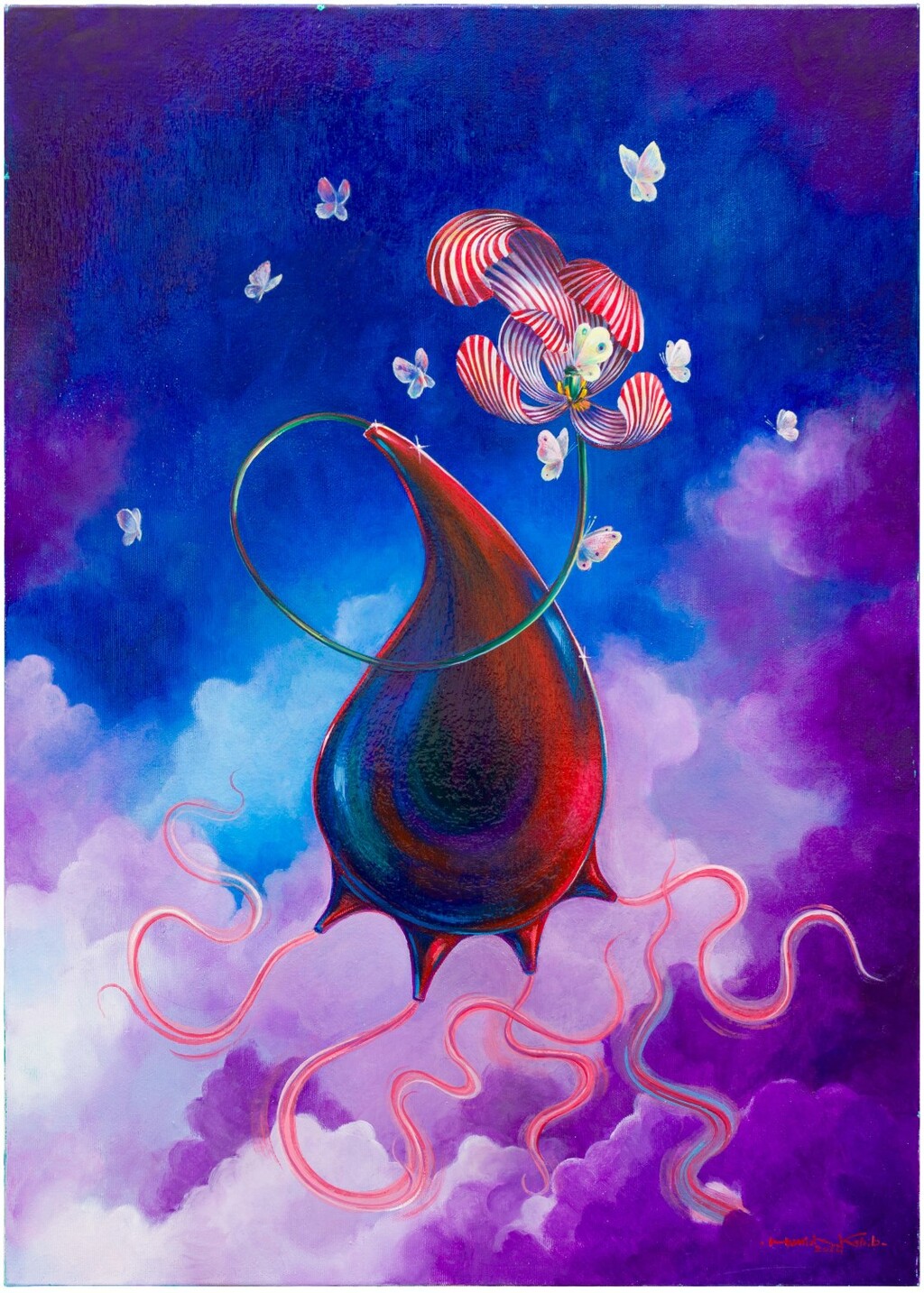
In an era of visual oversaturation, where images proliferate and are consumed with the feverish metabolism of the digital age, Hamid Nicola Katrib, through "Unguentum Apparatus", proposes a painting that suspends the immediacy of perception. This is a work that resists exhaustion through a single glance, demanding instead a slow immersion, a stratified deciphering, as though the eye must train itself for a new literacy of symbols.
In "Unguentum Apparatus", Katrib configures a pictorial space where the laws of matter are suspended, and form negotiates its own existence at the fragile boundary between revelation and evanescence. This work is neither a mere exercise in chromatic virtuosity nor a descent into superficial esoteric symbolism; rather, it operates as an incision into the very structure of perception, interrogating, through painting, the relationship between materiality and becoming, between the visible and the imperceptible.
/SUSPENDED EXISTENCE – BETWEEN OBJECT AND ARCHETYPE/
Like a translucent relic glimpsed through a lucid dream, the central object of the painting does not fit within any familiar taxonomic register. It is neither purely organic nor purely mechanical but an inflection of both registers, a potentiality sculpted in a moment of metaphysical suspension. At first glance, this "unguent apparatus" (if one were to take the title literally) does not evoke any recognisable utility. Yet, perhaps this is precisely where the key to interpretation lies - in the substitution of any functionality with a purely contemplative existence.
The central element appears as a relic of a future that has yet to occur - a post-biological object, a hybrid between an organic capsule and an enigmatic mechanism, whose tentacular roots seem to grasp at nothing. It is suspended, though not in the sense of abolished gravity, but rather as an existence that refuses any definitive anchoring. Its tentacles are neither gears nor vegetal nerves but filaments of dissipated energy, remnants of an uncertain contact with matter. The fact that this "body" emanates filamentary tentacles that do not seem to touch anything suggests that it has no determined purpose, only a pure, self-referential presence. It is neither a utilitarian mechanism nor a biological artefact but a transitional moment between the two, a manifestation of matter redefining itself into a new form.
This entity composes its own ambiguity through a structural duality - on one hand, its surface possesses a metallic sheen, indicating a degree of sophisticated artificiality; on the other, the flower emerging from its slender stem suggests an organic vital cycle, a growth that seems to defy the very nature of its support. The flower, striped in red and white, with petals resembling insect wings, is not merely an ornamental detail but a signal of an unprecedented mutation, a speculation on the becoming of forms.
What is striking is not only the presence of this flower but the fact that it coexists in perfect equilibrium with its technological substratum. Katrib does not juxtapose nature and technology; rather, he orchestrates their convergence in a manner that transcends traditional dichotomies. Thus, the painting functions as a visual meditation on the future of matter - not a dystopian future in which the mechanical suppresses organicity, but one in which notions of growth, evolution, and emergence become applicable to objects as well as to living beings.
The central figure refuses any anchoring, both in physical reality and in the conventions of classical representation. It is not positioned within a space that justifies it optically, nor does it seem to depend on any causal relationship with the background. Instead of a firm ground or a recognisable gravitational structure, it floats in a state of spatial neutrality, as though it exists not in a specific place, but within a pure concept.
This suspension is not merely a plastic effect - it problematizes the very notion of ontological belonging. If one were to think in Platonic terms, the object could be a simulacrum of an impossible archetype, an ephemeral materialisation of an entity that cannot be circumscribed within either an aesthetic or a technological category. It is a body-idea, a pictorial apparition that does not claim existence through reference but through its constitutive ambiguity.
/COLOUR AND THE CHROMATIC ABYSS – BETWEEN IMMERSION AND THE PHENOMENOLOGY OF PERCEPTION/
Colour is not merely a compositional instrument in this work - it constitutes the very ontological architecture of the painting. Katrib employs a saturated, profound blue, verging on violet, not as a passive background but as an active space of becoming. This blue is not atmospheric but mental - a dimension that does not describe a place but a mode of existence.
Within this spectrum, the central figure acquires its own luminosity, almost spectral. The reddish and purplish reflections on its "metallic" surface are not merely chromatic accents but phenomena of self-illumination - as though the object feeds on its own visual energy. This tension between inner light and surrounding darkness creates an effect of "apparition", akin to the visual phenomena experienced in states of deep reverie.
In this context, the butterflies that gravitate around the central form become more than mere lyrical accessories - they serve as indicators of an ontological revelation through perception. In alchemical traditions, the butterfly symbolises metamorphosis, the transition from one state of aggregation to another. Through their presence, the butterflies not only balance the composition but also problematize the relationship between permanence and ephemerality, between object and process. They are witnesses to a transformation that is neither physical nor symbolic but exists solely in the register of perception.
/ON THE TITLE – ALCHEMY, METAPHYSICS, AND TECHNOLOGY/
"Unguentum Apparatus" is a title that eludes immediate deciphering. If one takes "unguentum" in its Latin sense, it denotes an alchemical or medicinal substance, a fluid with transformative or healing properties. "Apparatus", on the other hand, evokes technicality - a mechanical ensemble designed for a precise function.
Yet the painting offers neither a recognisable mechanism nor a clear function. This contradiction between title and image is not merely an aesthetic strategy but a statement of principle - Katrib seems to suggest that all forms of knowledge are, in essence, processes of "constructing" reality. The unguent is not a physical substance here but a metaphor for the malleability of forms. The apparatus is not a tool in the strict technological sense but a conceptual device compelling us to reconfigure perception.
Thus, the painting becomes a perceptual experiment, an inquiry into how the human eye constructs meaning. If matter can be so volatile, so prone to metamorphosis, then perhaps all of reality is nothing more than a fluctuation of vision - a field of possibilities that modifies its structure according to the intensity of contemplation.
/IN LIEU OF A CONCLUSION – PAINTING AS AN INTERFACE BETWEEN REALITY AND DREAM/
"Unguentum Apparatus" is not a painting that permits a definitive interpretation. It is neither narrative nor symbolic in the classical sense but functions as a "perceptual device" - an interface between reality and a mental space situated beyond language.
Here, Katrib constructs not merely an image but a space for thought - a locus where the boundaries between the living and the inanimate, between object and phenomenon, between mechanics and dream, become indistinct. In contemplating this work, one is not merely faced with an art object but with a phenomenon, an apparition that seems to exist only insofar as it is beheld.
In a world where images are either narrative or decorative, "Unguentum Apparatus" is an exceptional act of subversion - a painting that refuses any predictable aesthetic function and instead demands that we become witnesses to an ontological metamorphosis. It is a fragment of a dream that belongs to no one, a relic of a reality yet to be born.
